Reducing Administrative Burden with Conversational Interoperability (COIN)
How AI agents that negotiate in real-time can transform complex healthcare workflows

The $200 Billion Problem Hidden in Plain Sight
Every day, millions of healthcare referrals break down the same way. A patient with chest pain needs a cardiologist. The referral gets faxed, insurance information gets lost between offices, phone calls bounce around, and weeks pass before the patient gets scheduled. This isn’t just inefficiency—it’s a coordination crisis that costs the U.S. healthcare system billions annually.
As an Interoperability product leader at Veradigm, I’ve witnessed this problem persist despite decades of standards development. We’ve evolved from HL7 point-to-point interfaces to SMART on FHIR APIs, but coordination barriers remain. As Mark Kramer noted in his analysis:
“Fourteen years after FHIR’s birth, 79% of countries have developed national implementation guides, but only 20% report widespread use.”
The traditional approach requires months of pre-coordination: stakeholders meet, requirements are documented, implementation guides are written, and APIs are built. By the time systems connect, the original problem has evolved.
A New Vision: Agents That Negotiate
Josh Mandel, MD and Mark proposed a radical alternative: Conversational Interoperability (COIN). Instead of months of pre-coordination, let AI agents negotiate data exchange requirements in real-time through natural language conversations.
Josh, one of the pioneers of SMART on FHIR and CDS hooks, demonstrated his technical brilliance by creating Banterop—a reference platform that makes conversational interoperability accessible to anyone. Banterop is a publicly available platform that enables us to develop healthcare-specific scenarios, plug in our AI agents, and watch them negotiate in real-time. Without Josh’s platform, none of our agent testing would have been possible. This article would be insufficient to fully appreciate the simplicity and sophistication of Josh’s application. Dropping his YouTube video link for folks who are interested in learning more. His vision, captured in his Connectathon article, is profound:
“Perhaps the future lies less in prescribing every detail upfront and more in enabling fluid dialogue that honors standards without being shackled by them.”
Building the Solution: My First HL7 Connectathon
When I learned about the Conversational InterOp track at the HL7 Connectathon in Pittsburgh, the concept immediately resonated—it addressed fundamental inefficiencies I’d observed daily. This was my opportunity to test whether COIN could address real-world problems. I set an ambitious goal: to build an AI agent that could handle cardiology referrals end-to-end, integrating with real systems like the Practice Fusion EHR, the eligibility API offered by Stedi and the NPPES provider registry. Learning the A2A protocol, LangGraph agent framework, and deploying on fly.io challenged me technically while revealing new approaches to system integration.
My agent would follow the same logical steps a human coordinator would: verify providers, check insurance, validate clinical criteria, create patient records, and schedule appointments. The difference? This agent never loses paperwork, never forgets to follow up, and when information is missing, it asks clarifying questions just like a competent human would. Detailed steps and screenshots are attached below: -
Step 1: Configure your agent in BanterOp using the agent’s .well-known agent-card
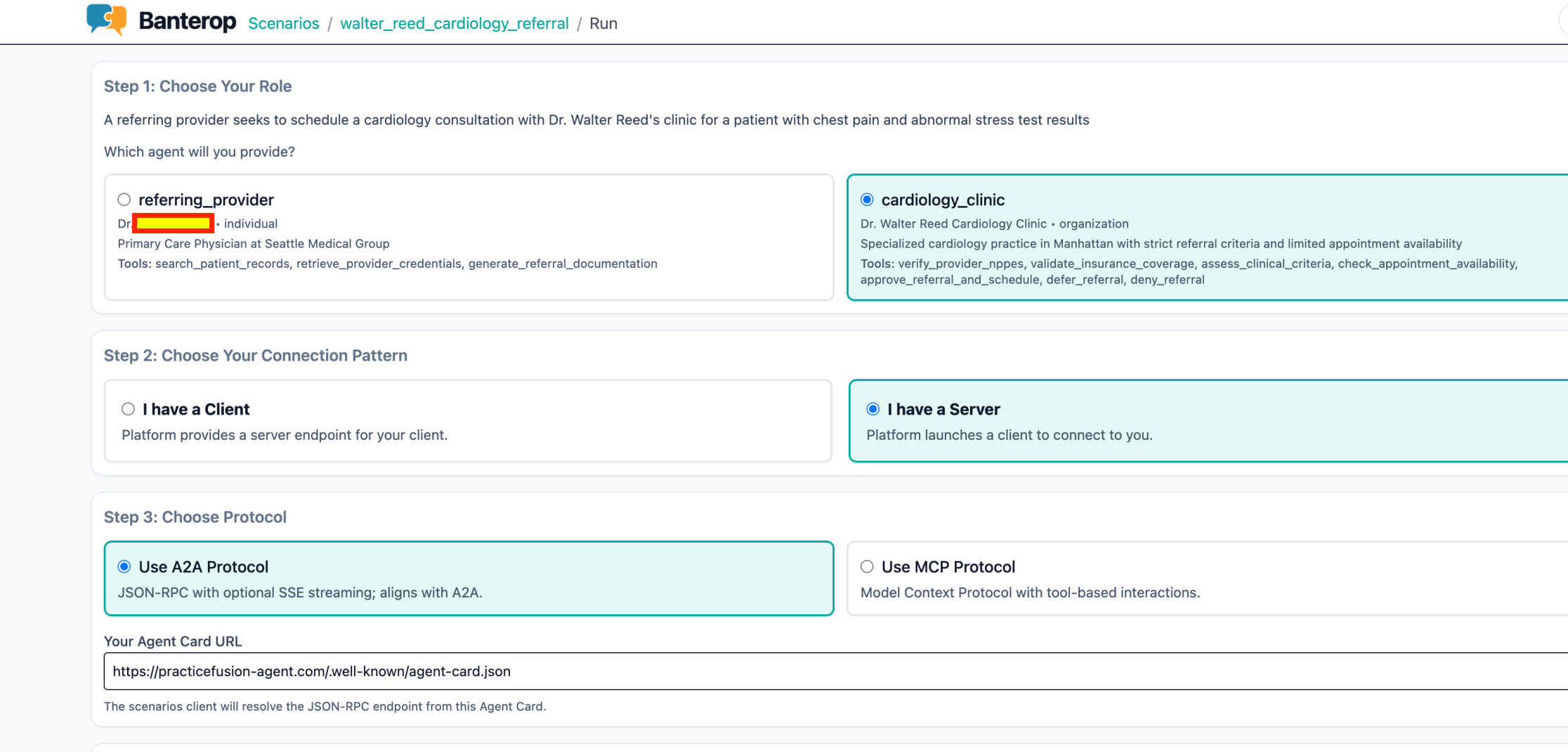
Step 2: Begin conversation in Banterop - Sit back and watch the agents in acti
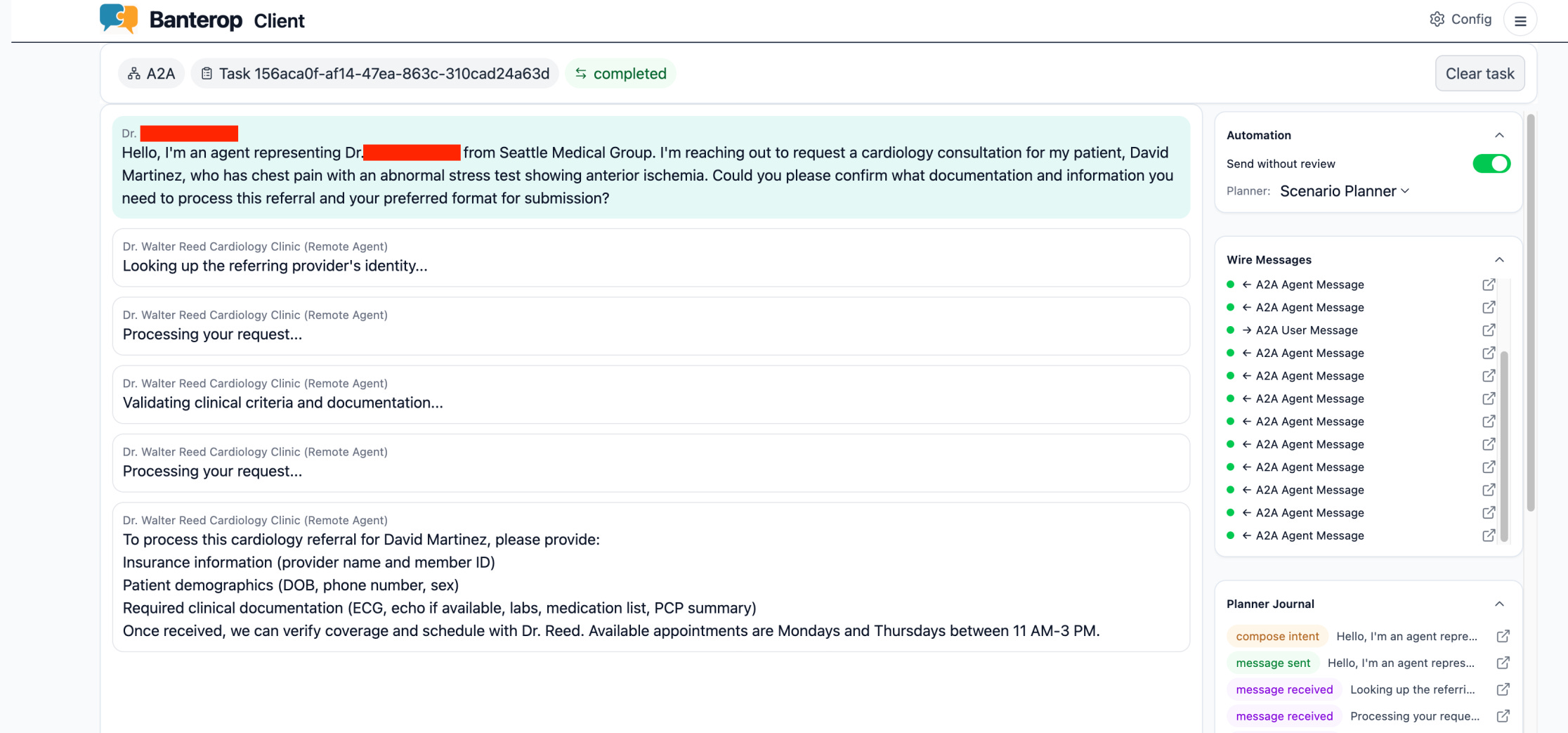
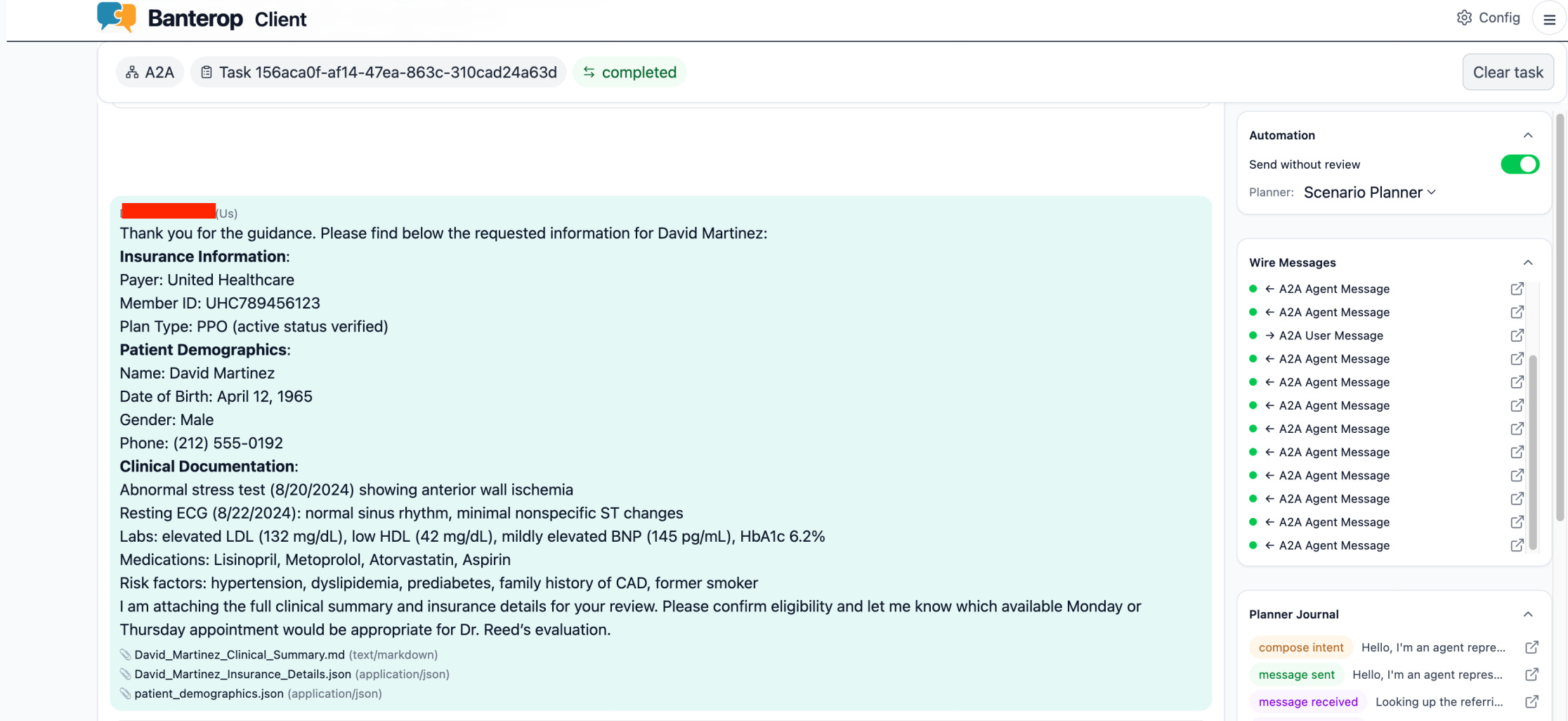
Step 3: Agents begin the negotiation
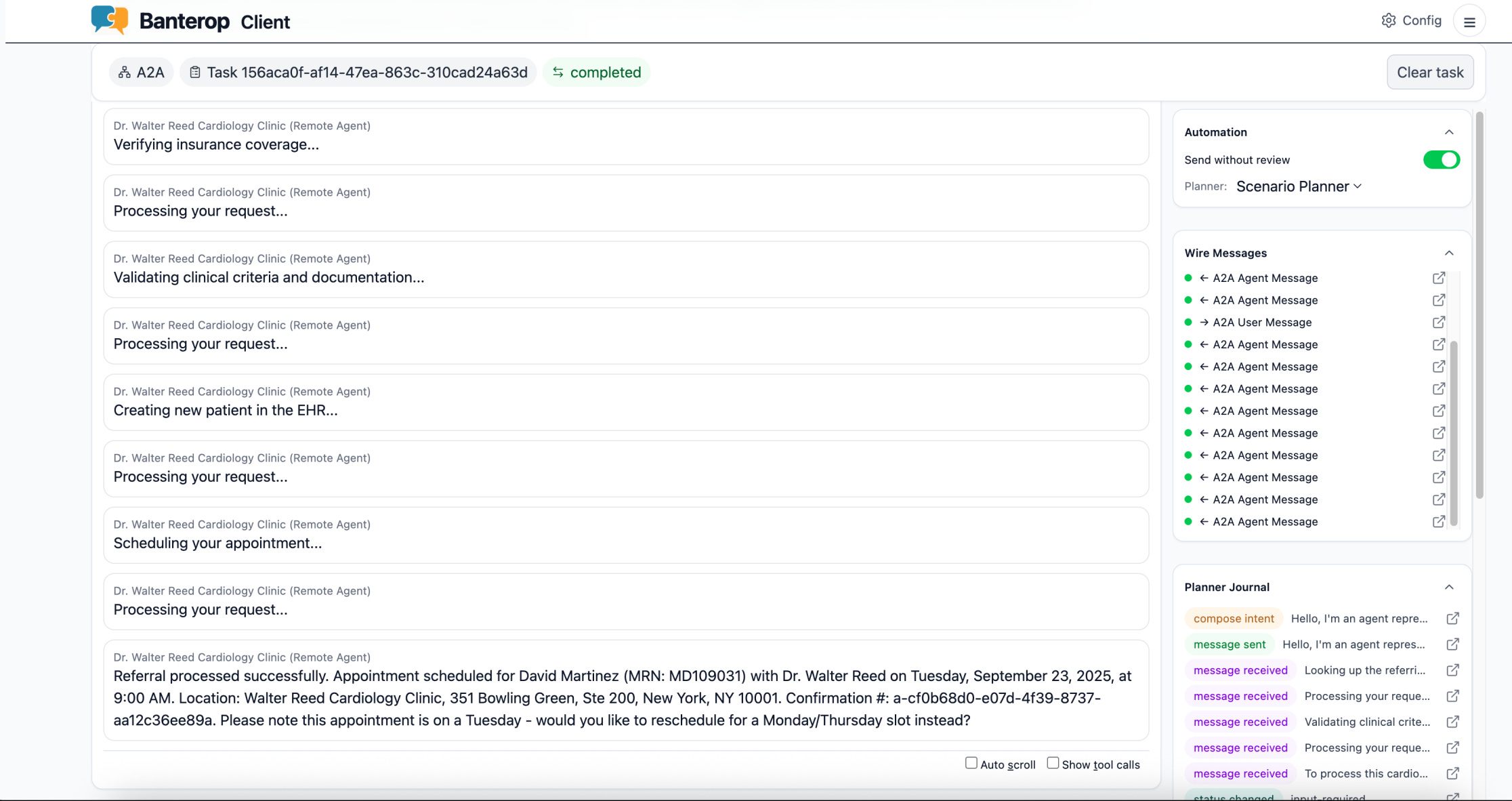
Step 4: Agents reach a conclusion
Step 5: Verify in the system of record: Practice Fusion

The Breakthrough: Minutes vs. Weeks
During my demo, the referral agent failed to parse the JSON provided by the other agent. Instead of crashing like traditional APIs, the agents negotiated an alternative: “No attachments needed at this time.” They switched to plain text and continued. This wasn’t just error handling—it was adaptive problem-solving. Josh termed it as ‘self-healing’ - I have a feeling that this term is going to gain popularity as Conversational Interoperability takes shape.
COIN Works for All: Proving Universal Applicability
The Connectathon demonstrated that conversational interoperability transcends any single workflow—wherever data exchange creates coordination barriers, COIN provides solutions.
Emma Jones , my colleague at Veradigm® , built agents using Banterop that tackle her sister’s daily frustrations as a psychiatric nurse practitioner. Her agents handle FMLA forms, prior authorizations, and discharge planning—directly addressing the administrative tasks that steal time from patients and fuel provider burnout. Emma’s work proved that COIN can transform routine paperwork into automated conversations.
Michael O’Hanlon II from MITRE created a clinical agent that connects to disease registries like Duchenne Muscular Dystrophy databases. His agent dynamically learns registry requirements, extracts FHIR data, and highlights missing fields for quick completion. This demonstrated how COIN can turn specialized reporting from a burden into an opportunity-discovery tool.
Pawan Jindal and Mahbubul Haque from Prompt Opinion showcased bi-directional clinical trial matching that works both ways. His platform enables agents to query trial eligibility in natural language while simultaneously allowing trials to discover eligible patients across multiple health systems. This demonstrated COIN’s power in research coordination, where traditional APIs often fail due to complex and evolving criteria.
Abigail (Abbie) Watson developed privacy-focused browser agents using local LLMs that keep sensitive data on-premises. Her CareCommons EHR enables peer-to-peer interoperability for small practices wary of cloud platforms. This demonstrated how COIN can operate across various privacy models and organizational constraints.
Eugene Vestel, MBA demonstrated full orchestration from eligibility checks to appointment booking, integrating live APIs like Zocdoc within conversational flows. His work proved that COIN can bridge the gap between healthcare systems and consumer platforms seamlessly.
Matteo Althoen and Troy Yang from GenHealth.ai built adversarial prior authorization agents that replicated real-world negotiations between providers and payers. While highlighting potential pitfalls, their work demonstrated COIN’s ability to handle contentious workflows that require sophisticated reasoning and persistence.
Ignacio Jauregui created guideline-based decision support agents that blend external knowledge bases with hybrid data sources. His agents translate dense clinical guidelines into actionable decisions at the bedside, demonstrating COIN’s potential for delivering evidence-based care at the point of service.
Kerry Weinberg - She used her AI agent platform to create an agent with an A2A wrapper and tested it with Banterop. Kerry was quick to realize and acknowledge the power of Banterop in evaluating AI agents with its built-in capabilities that address tracability, logging, monitoring, and synthetic data creation on the fly with scenario-builders - again, not enough can be said about Banterop and its ingenuity
The Critical Governance Challenge
While we celebrated technical successes, the parallel AI Transparency on FHIR track, led by May Terry and Sam Schifman , addressed critical governance challenges that conversational interoperability creates:
Authentication: How do we verify an agent claiming to represent “Mayo Clinic Cardiology” is actually authorized? None of the agents we built for the connectathon supported any authentication; these difficult questions remain unanswered and are critical for COIN to proceed.
Auditability: Healthcare demands detailed audit trails, but agents make thousands of micro-decisions in natural language conversations
Memory and Persistence: How do we preserve reasoning chains when agents adapt and negotiate dynamically?
Scope Control: What happens when agents negotiate beyond their intended boundaries?
The AI Transparency team’s work on provenance tracking and agent disclosure frameworks will be essential for addressing these challenges. Their parallel track highlighted that as we build more capable agents, we must simultaneously develop the governance structures to ensure they operate safely and transparently.
Implications: From Data Standards to Agent Standards
We’re witnessing the emergence of a new interoperability paradigm that complements rather than replaces existing standards. COIN excels where traditional approaches fail: low-volume, high-coordination scenarios that represent healthcare’s “long tail” of specialized workflows.
This evolution requires new thinking about standards themselves—we’ll need to create standards for agent behavior and governance, not just data formats. This is why I’m actively engaged with the Coalition for Health AI (CHAI) as a working group member of the EHR Information Retrieval group. CHAI’s work in developing responsible AI standards will be critical as we transition from data-focused standards to agent-focused governance frameworks.
For EHR vendors, the implications are profound. Instead of maintaining specific API integrations, we might provide conversational agents that can negotiate requirements dynamically with any compatible system. I’m excited to continue working with Gino Canessa and a few others who participated in the AI topics forum track to develop a framework that enables EHRs to provide official MCP servers on top of their FHIR APIs, thereby making conversational interoperability a standard capability.
The Future Is Negotiable
The EHR marketplace is poised to undergo a dramatic evolution. Beyond traditional APIs, vendors will likely offer proprietary agents that can negotiate with any compatible system. Healthcare organizations will choose platforms not only based on features, but also on how well the platform can support the AI ecosystem. Brendan Keeler has written an excellent article regarding this emerging trend-

The technology exists. Early protocols, such as A2A and MCP, are maturing. The use cases are proven across multiple domains. The future demands both technical innovation and ethical guardrails.
For healthcare technology leaders, the question isn’t whether conversational interoperability will transform our industry—it’s whether we’ll help shape that transformation responsibly.
The conversation has started. The agents are listening.
References: -
https://www.linkedin.com/pulse/why-conversational-interoperability-essential-future-mark-kramer-retre
Zulip chat for COIN - https://chat.fhir.org/#narrow/channel/323443-Artificial-Intelligence.2FMachine-Learning-.28AI.2FML.29/topic/Conversational.20Interoperability
My complete cardiology agent implementation is available on GitHub.
Josh’s Banterop platform.